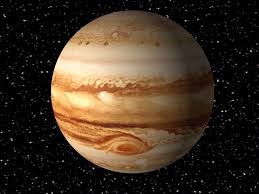
Jupiter is the fifth planet from the Sun and the largest in the Solar System. It is a gas giant with a mass more than two and a half times that of all the other planets in the Solar System combined, but slightly less than one-thousandth the mass of the Sun. Jupiter is the third brightest natural object in the Earth’s night sky after the Moon and Venus, and it has been observed since prehistoric times. It was named after the Roman god Jupiter, the king of the gods.
Jupiter is primarily composed of hydrogen, but helium constitutes one-quarter of its mass and one-tenth of its volume. It probably has a rocky core of heavier elements, but, like the other giant planets in the Solar System, it lacks a well-defined solid surface. The ongoing contraction of Jupiter’s interior generates more heat than it receives from the Sun. Because of its rapid rotation, the planet’s shape is an oblate spheroid: it has a slight but noticeable bulge around the equator. The outer atmosphere is divided into a series of latitudinal bands, with turbulence and storms along their interacting boundaries. A prominent result of this is the Great Red Spot, a giant storm which has been observed since at least 1831.
Jupiter is surrounded by a faint planetary ring system and a powerful magnetosphere. Jupiter’s magnetic tail is nearly long, covering nearly the entire distance to Saturn’s orbit. Jupiter has 80 known moons and possibly many more, including the four large moons discovered by Galileo Galilei in 1610: Io, Europa, Ganymede, and Callisto. Io and Europa are about the size of Earth’s Moon; Callisto is almost the size of the planet Mercury, and Ganymede is larger
 Arshii Sangar
Leave a comment