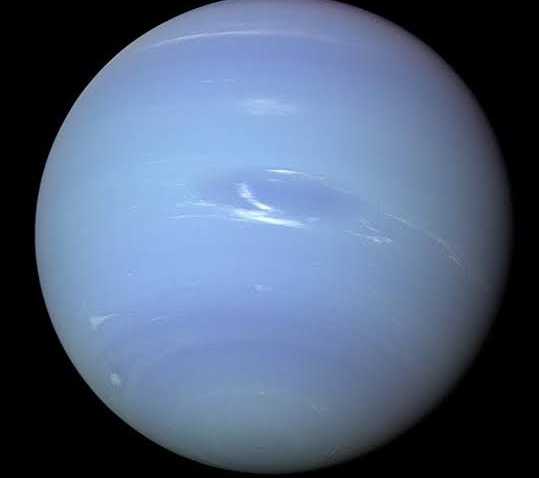
Neptune is the eighth planet from the Sun and the farthest known solar planet. In the Solar System, it is the fourth-largest planet by diameter, the third-most-massive planet, and the densest giant planet. It is 17 times the mass of Earth, and slightly more massive than its near-twin Uranus. Neptune is denser and physically smaller than Uranus because its greater mass causes more gravitational compression of its atmosphere. It is referred to as one of the solar system’s two ice giant planets.
Being composed primarily of gases and liquids, it has no well-defined “solid surface”. The planet orbits the Sun once every 164.8 years at an average distance of. It is named after the Roman god of the sea and has the astronomical symbol, representing Neptune’s trident.
Neptune is not visible to the unaided eye and is the only planet in the Solar System found by mathematical prediction rather than by empirical observation. Unexpected changes in the orbit of Uranus led Alexis Bouvard to hypothesise that its orbit was subject to gravitational perturbation by an unknown planet. After Bouvard’s death, the position of Neptune was predicted from his observations, independently, by John Couch Adams and Urbain Le Verrier. Neptune was subsequently observed with a telescope on 23 September 1846 The advent of the Hubble Space Telescope and large ground-based telescopes with adaptive optics has recently allowed for additional detailed observations from afar.
Like Jupiter and Saturn, Neptune’s atmosphere is composed primarily of hydrogen and helium, along with traces of hydrocarbons and possibly nitrogen, though it contains a higher proportion of ices such as water, ammonia and methane. However, similar to Uranus, its interior is primarily composed of ices and rock; Newest data from the Gemini observatory shows the blue color is more saturated than the one present on Uranus due to thinner haze of Neptune’s more active atmosphere.
In contrast to the hazy, relatively featureless atmosphere of Uranus, Neptune’s atmosphere has active and visible weather patterns. For example, at the time of the Voyager 2 flyby in 1989, the planet’s southern hemisphere had a Great Dark Spot comparable to the Great Red Spot on Jupiter. More recently, in 2018, a newer main dark spot and smaller dark spot were identified and studied. Because of its great distance from the Sun, Neptune’s outer atmosphere is one of the coldest places in the Solar System, with temperatures at its cloud tops approaching. Temperatures at the planet’s centre are approximately. Hence, he is not credited with Neptune’s discovery. At his first observation in December 1612, Neptune was almost stationary in the sky because it had just turned retrograde that day. This apparent backward motion is created when Earth’s orbit takes it past an outer planet. Because Neptune was only beginning its yearly retrograde cycle, the motion of the planet was far too slight to be detected with Galileo’s small telescope. In 2009, a study suggested that Galileo was at least aware that the “star” he had observed had moved relative to the fixed stars.
In 1821, Alexis Bouvard published astronomical tables of the orbit of Neptune’s neighbour Uranus. Subsequent observations revealed substantial deviations from the tables, leading Bouvard to hypothesise that an unknown body was perturbing the orbit through gravitational interaction
 Arshii Sangar
Leave a comment