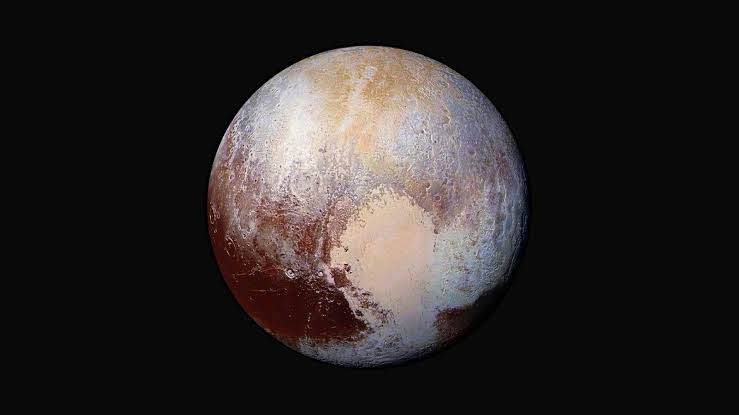
Pluto is a dwarf planet in the Kuiper belt, a ring of bodies beyond the orbit of Neptune. In 1930, it was the first object discovered in the Kuiper belt, when it was declared the ninth planet from the Sun. Beginning in the 1990s, following the discovery of several objects of similar size in the Kuiper belt including the dwarf planet Eris, and the scattered disc, Pluto’s status as a planet was questioned. In 2006 the International Astronomical Union formally re-defined the term planet, reclassifying Pluto as a dwarf planet.
Pluto is the ninth-largest and tenth-most-massive known object directly orbiting the Sun. It is the largest known trans-Neptunian object by volume, but is less massive than Eris. Like other Kuiper belt objects, Pluto is primarily made of ice and rock and is relatively small. Compared to Earth’s Moon, Pluto has only one sixth the mass, and one third the volume.
Pluto has a moderately eccentric and inclined orbit, ranging from from the Sun. Light from the Sun takes 5.5 hours to reach Pluto at its average distance. Pluto’s eccentric orbit periodically brings it closer to the Sun than Neptune, but a stable orbital resonance prevents them from colliding.
Pluto has five known moons. Charon the largest, whose diameter is just over half that of Pluto, Styx, Nix, Kerberos, and Hydra. Pluto and Charon are sometimes considered a binary system because the barycenter of their orbits does not lie within either body, and they are tidally locked.
The New Horizons became the first spacecraft to perform a brief flyby of Pluto on July 14, 2015, making detailed measurements and observations of Pluto and its moons. In September 2016, astronomers announced that the reddish-brown cap of the north pole of Charon is composed of tholins, organic macromolecules that may be ingredients for the emergence of life, produced from methane, nitrogen, and other gases released from the atmosphere of Pluto and transferred to the orbiting moon.
History
Discovery
In the 1840s, Urbain Le Verrier used Newtonian mechanics to predict the position of the then-undiscovered planet Neptune after analyzing perturbations in the orbit of Uranus. Subsequent observations of Neptune in the late 19th century led astronomers to speculate that Uranus’s orbit was being disturbed by another planet besides Neptune.
In 1906, Percival Lowell—a wealthy Bostonian who had founded Lowell Observatory in Flagstaff, Arizona, in 1894—started an extensive project in search of a possible ninth planet, which he termed “Planet X”.
 Arshii Sangar
Leave a comment