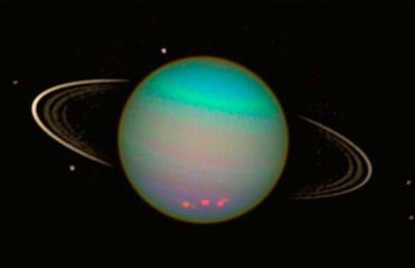
Uranus is the seventh planet from the Sun. Its name is a reference to the Greek god of the sky, Uranus, who, according to Greek mythology, was the great-grandfather of Ares, grandfather of Zeus and father of Cronus. It has the third-largest planetary radius and fourth-largest planetary mass in the Solar System. Uranus is similar in composition to Neptune, and both have bulk chemical compositions which differ from that of the larger gas giants Jupiter and Saturn. For this reason, scientists often classify Uranus and Neptune as “ice giants” to distinguish them from the other giant planets.
As with gas giants, ice giants also lack a well defined “solid surface.” Uranus’s atmosphere is similar to Jupiter’s and Saturn’s in its primary composition of hydrogen and helium, but it contains more “ices” such as water, ammonia, and methane, along with traces of other hydrocarbons. Observations from Earth have shown seasonal change and increased weather activity as Uranus approached its equinox in 2007. Wind speeds can reach. Sir William Herschel first observed Uranus on 13 March 1781, leading to its discovery as a planet, expanding the known boundaries of the Solar System for the first time in history and making Uranus the first planet classified as such with the aid of a telescope.
Discovery
Uranus had been observed on many occasions before its recognition as a planet, but it was generally mistaken for a star. Possibly the earliest known observation was by Hipparchos, who in 128 BC might have recorded it as a star for his star catalogue that was later incorporated into Ptolemy’s Almagest. The earliest definite sighting was in 1690, when John Flamsteed observed it at least six times, cataloguing it as 34 Tauri. The French astronomer Pierre Charles Le Monnier observed Uranus at least twelve times between 1750 and 1769, including on four consecutive nights.
Sir William Herschel observed Uranus on 13 March 1781 from the garden of his house at 19 New King Street in Bath, Somerset, England, and initially reported it as a comet. With a homemade 6.2-inch reflecting telescope, Herschel “engaged in a series of observations on the parallax of the fixed stars.”
Herschel recorded in his journal: “In the quartile near ζ Tauri… either Nebulous star or perhaps a comet.” On 17 March he noted: “I looked for the Comet or Nebulous Star and found that it is a Comet, for it has changed its place.” When he presented his discovery to the Royal Society, he continued to assert that he had found a comet, but also implicitly compared it to a planet:
Although Herschel continued to describe his new object as a comet, other astronomers had already begun to suspect otherwise. Finnish-Swedish astronomer Anders Johan Lexell, working in Russia, was the first to compute the orbit of the new object. Bode concluded that its near-circular orbit was more like a planet’s than a comet’s.
The object was soon universally accepted as a new planet. By 1783, Herschel acknowledged this to Royal Society president Joseph Banks: “By the observation of the most eminent Astronomers in Europe it appears that the new star, which I had the honour of pointing out to them in March 1781, is a Primary Planet of our Solar System.” The pronunciation of the name Uranus preferred among astronomers is with stress on the first syllable as in Latin Ūranus, in contrast to with stress on the second syllable and a long a, though both are considered acceptable
 Arshii Sangar
Leave a comment