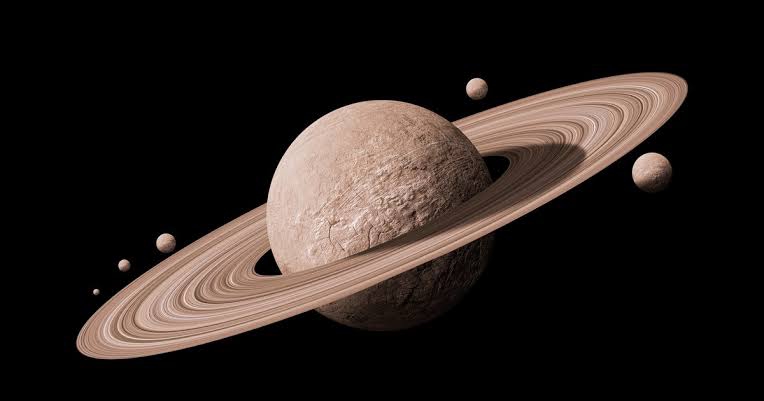
Saturn is the sixth planet from the Sun and the second-largest in the Solar System, after Jupiter. It is a gas giant with an average radius of about nine and a half times that of Earth. It has only one-eighth the average density of Earth; however, with its larger volume, Saturn is over 95 times more massive.
The planet’s most notable feature is its prominent ring system, which is composed mainly of ice particles, with a smaller amount of rocky debris and dust. At least 83 moons are known to orbit Saturn, of which 53 are officially named; this does not include the hundreds of moonlets in its rings. Titan, Saturn’s largest moon and the second largest in the Solar System, is larger than the planet Mercury, although less massive, and is the only moon in the Solar System to have a substantial atmosphere.
Name and symbol
Saturn is named after the Roman god of wealth and agriculture and father of Jupiter. Its astronomical symbol.svg 16px ♄]]) has been traced back to the Greek Oxyrhynchus Papyri, where it can be seen to be a Greek kappa-rho with a horizontal stroke, as an abbreviation for Κρονος, the Greek name for the planet.
It later came to look like a lower-case Greek eta, with the cross added at the top in the 16th century to Christianize this pagan symbol.
The Romans named the seventh day of the week Saturday, Sāturni diēs, for the planet Saturn.
Physical characteristics
Saturn is a gas giant composed predominantly of hydrogen and helium. It lacks a definite surface, though it is likely to have a solid core.
Saturn is the only planet of the Solar System that is less dense than water—about 30% less.
This core is similar in composition to Earth, but is more dense. The examination of Saturn’s gravitational moment, in combination with physical models of the interior, has allowed constraints to be placed on the mass of Saturn’s core. In 2004, scientists estimated that the core must be 9–22 times the mass of Earth, However, measurements of Saturn’s rings suggest a much more diffuse core with a mass equal to about 17 Earths and a radius equal to around 60% of Saturn’s entire radius. This is surrounded by a thicker liquid metallic hydrogen layer, followed by a liquid layer of helium-saturated molecular hydrogen that gradually transitions to a gas with increasing altitude. The outermost layer spans 1,000 km and consists of gas.
 Arshii Sangar
Leave a comment