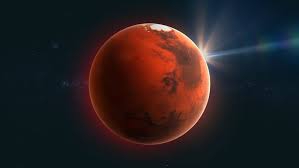
Mars is the fourth planet from the Sun and the second-smallest planet in the Solar System, being larger than only Mercury. In the English language, Mars is named for the Roman god of war. Mars is a terrestrial planet with a thin atmosphere, and has a crust primarily composed of elements similar to Earth’s crust, as well as a core made of iron and nickel. Mars has surface features such as impact craters, valleys, dunes, and polar ice caps. It has two small and irregularly shaped moons: Phobos and Deimos.
Some of the most notable surface features on Mars include Olympus Mons, the largest volcano and highest known mountain on any planet in the Solar System, and Valles Marineris, one of the largest canyons in the Solar System. The Borealis basin in the Northern Hemisphere covers approximately 40% of the planet and may be a large impact feature. Both of Mars’s polar ice caps appear to be made largely of water. In the distant past, Mars was likely wetter, and thus possibly more suited for life. However, it is unknown whether life has ever existed on Mars.
Mars has been explored by several uncrewed spacecraft, beginning with Mariner 4 in 1965. NASA’s Viking 1 lander transmitted in 1976 the first images from the Martian surface. Two countries have successfully deployed rovers on Mars, the United States first doing so with Sojourner in 1997 and China with Zhurong in 2021. There are also planned future missions to Mars, such as a Mars sample-return mission set to happen in 2026, and the Rosalind Franklin rover mission, which was intended to launch in 2018 but was delayed to 2024 at the earliest, with a more likely launch date at 2028.
Mars can be viewed from Earth with the naked eye, as can its reddish coloring. This appearance, due to the iron oxide prevalent on its surface, has led to Mars often being called the Red Planet. In Mesopotamian texts, Mars is referred to as the “star of judgement of the fate of the dead.” The existence of Mars as a wandering object in the night sky was also recorded by the ancient Egyptian astronomers and, by 1534 BCE, they were familiar with the retrograde motion of the planet.
 Arshii Sangar