Sun
Uploaded on Aug 17, 2022
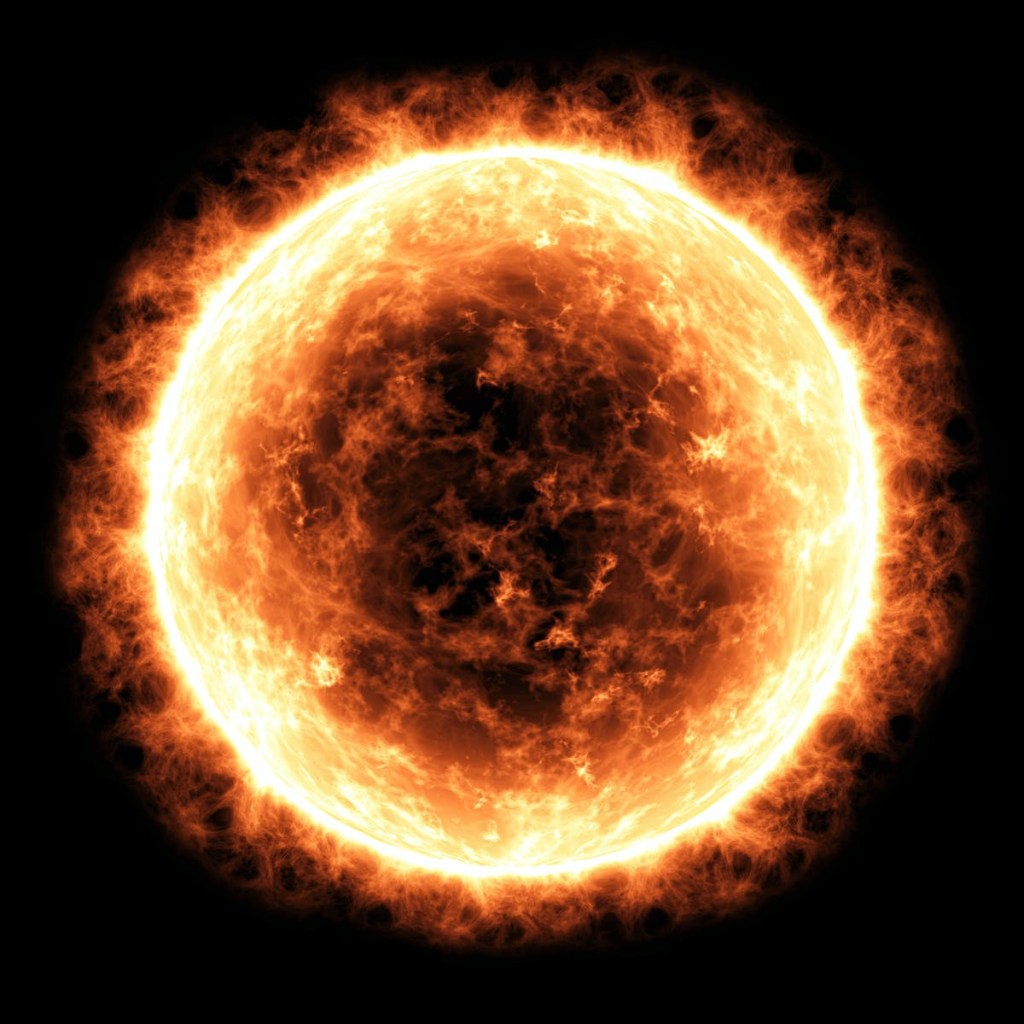
The Sun is the star at the center of the Solar System. It is a nearly perfect ball of hot plasma, heated to incandescence by nuclear fusion reactions in its core, radiating the energy mainly as light, ultraviolet, and infrared radiation. It is the most important source of energy for life on Earth.
The Sun’s radius is about or 109 times that of Earth. Its mass is about 330,000 times that of Earth, comprising about 99.86% of the total mass of the Solar System. Roughly three-quarters of the Sun’s mass consists of hydrogen ; the rest is mostly helium, with much smaller quantities of heavier elements, including oxygen, carbon, neon, and iron.
The Sun is a G-type main-sequence star. As such, it is informally, and not completely accurately, referred to as a yellow dwarf. It formed approximately 4.6 billion years ago from the gravitational collapse of matter within a region of a large molecular cloud. Most of this matter gathered in the center, whereas the rest flattened into an orbiting disk that became the Solar System. The central mass became so hot and dense that it eventually initiated nuclear fusion in its core. It is thought that almost all stars form by this process.
Every second, the Sun’s core fuses about 600 million tons of hydrogen into helium, and in the process converts 4 million tons of matter into energy. This energy, which can take between 10,000 and 170,000 years to escape the core, is the source of the Sun’s light and heat. When hydrogen fusion in its core has diminished to the point at which the Sun is no longer in hydrostatic equilibrium, its core will undergo a marked increase in density and temperature while its outer layers expand, eventually transforming the Sun into a red giant. It is calculated that the Sun will become sufficiently large to engulf the current orbits of Mercury and Venus, and render Earth uninhabitable – but not for about five billion years. After this, it will shed its outer layers and become a dense type of cooling star known as a white dwarf, and no longer produce energy by fusion, but still glow and give off heat from its previous fusion.
The enormous effect of the Sun on Earth has been recognized since prehistoric times. The Sun was thought of by some cultures as a deity. The synodic rotation of Earth and its orbit around the Sun are the basis of some solar calendars. The predominant calendar in use today is the Gregorian calendar which is based upon the standard 16th-century interpretation of the Sun’s observed movement as actual movement.
Etymology
The English word sun developed from Old English sunne. Cognates appear in other Germanic languages, including West Frisian sinne, Dutch zon, Low German Sünn, Standard German Sonne, Bavarian Sunna, Old Norse sunna, and Gothic sunnō. All these words stem from Proto-Germanic. This is ultimately related to the word for sun in other branches of the Indo-European language family, though in most cases a nominative stem with an l is found, rather than the genitive stem in n, as for example in Latin sōl, ancient Greek ἥλιος, Welsh haul and Russian солнце, as well as Sanskrit स्वर and Persian خور. Indeed, the l-stem survived in Proto-Germanic as well, as which gave rise to Gothic sauil and Old Norse prosaic sól, and through it the words for sun in the modern Scandinavian languages: Swedish and Danish solen, Icelandic sólin, etc. from Latin sol – the latter found in terms such as solar day, solar eclipse and Solar System. From the Greek comes the rare adjective heliac. In English, the Greek and Latin words occur in poetry as personifications of the Sun, Helios and Sol, while in science fiction Sol may be used as a name for the Sun to distinguish it from other stars. The term sol with a lower-case s is used by planetary astronomers for the duration of a solar day on another planet such as Mars.
Our Earth and it’s developement
Uploaded on Aug 16, 2022
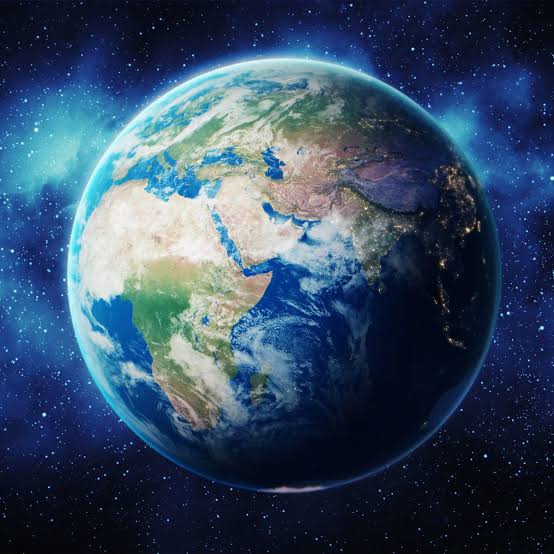
Our earth is 4.9 Billion years old. And it’s future age is also about 5 billion years. It is a part of sun. But now our earth has been changed a lot. The humans on earth has been arrived on earth from these last 750 Million years ago. The earth has taken too much time to develop his shape in this beautiful nature. But human has develop his own in these 750 million years.
Our earth has 78% Nitrogen, 21% Oxygen, 0.9% argon and 0.1% other gases included in this. Our earth has a shape of looking like egg. Our earth has a size of 12,750 km in diameter. Our earth has a gravitational force in negative direction. The gravitational force size is 6,400 km from the core of the earth. The earth has 71% water and the 29% land. But from all the water,only 1% water is usable for us. The other water has consists NaCL which human body can’t digest and can occur vey big problems. The wood is the biggest natural resource founded on the earth. The moon is a part of the earth that has made from a biggest story behind in this. But now the earth’s temperature is changed by human activities and growth
The dinosaurs on the earth live at the past of crores years from now. They live in the very big population on earth. Then a big asteroid named CHICXULUB arrived on the earth and hit the earth. The asteroid destroyed the earth at a very big threat. The dinosaurs been depleted and the small mammals on the earth were been live below the earth. They been all survived. And they were been developed after and after. They all mammals are converted into monkeys. And they monkeys were converted into humans. And they humans are now us on earth. But human has threatened his earth at a very big level. We need to secure our earth to be pollution free. We need to reserve our earth by becoming anti-Plastic. We need to reserve our planet. We need to reserve our natural resources. The humans have increased, but the earth has decreased.
Independence day : India
Uploaded on Aug 15,2022
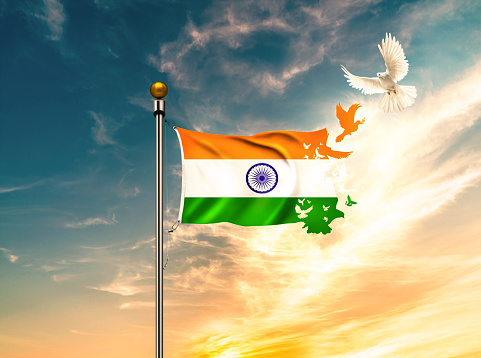
India, officially the Republic of India, is a country in South Asia. It is the seventh-largest country by area, the second-most populous country, and the most populous democracy in the world. Bounded by the Indian Ocean on the south, the Arabian Sea on the southwest, and the Bay of Bengal on the southeast, it shares land borders with Pakistan to the west; China, Nepal, and Bhutan to the north; and Bangladesh and Myanmar to the east. In the Indian Ocean, India is in the vicinity of Sri Lanka and the Maldives; its Andaman and Nicobar Islands share a maritime border with Thailand, Myanmar and Indonesia. India is the sixth largest economy in the world as per World Bank data in 2021.
Modern humans arrived on the Indian subcontinent from Africa no later than 55,000 years ago.
Their long occupation, initially in varying forms of isolation as hunter-gatherers, has made the region highly diverse, second only to Africa in human genetic diversity. Settled life emerged on the subcontinent in the western margins of the Indus river basin 9,000 years ago, evolving gradually into the Indus Valley civilisation of the third millennium BCE.
By an archaic form of Sanskrit, an Indo-European language, had diffused into India from the northwest, unfolding as the language of the Rigveda, and recording the dawning of Hinduism in India. The Dravidian languages of India were supplanted in the northern and western regions.
By stratification and exclusion by caste had emerged within Hinduism,
and Buddhism and Jainism had arisen, proclaiming social orders unlinked to heredity.
Early political consolidations gave rise to the loose-knit Maurya and Gupta Empires based in the Ganges Basin.
Their collective era was suffused with wide-ranging creativity, but also marked by the declining status of women, and the incorporation of untouchability into an organised system of belief. In South India, the Middle kingdoms exported Dravidian-languages scripts and religious cultures to the kingdoms of Southeast Asia.
In the early medieval era, Christianity, Islam, Judaism, and Zoroastrianism became established on India’s southern and western coasts.
Muslim armies from Central Asia intermittently overran India’s northern plains,
eventually founding the Delhi Sultanate, and drawing northern India into the cosmopolitan networks of medieval Islam.
In the 15th century, the Vijayanagara Empire created a long-lasting composite Hindu culture in south India.
In the Punjab, Sikhism emerged, rejecting institutionalised religion.
The Mughal Empire, in 1526, ushered in two centuries of relative peace,
leaving a legacy of luminous architecture.
Gradually expanding rule of the British East India Company followed, turning India into a colonial economy, but also consolidating its sovereignty. British Crown rule began in 1858. The rights promised to Indians were granted slowly, but technological changes were introduced, and ideas of education, modernity and the public life took root. A pioneering and influential nationalist movement emerged, which was noted for nonviolent resistance and became the major factor in ending British rule. In 1947 the British Indian Empire was partitioned into two independent dominions, a Hindu-majority Dominion of India and a Muslim-majority Dominion of Pakistan, amid large-scale loss of life and an unprecedented migration.
India has been a federal republic since 1950, governed through a democratic parliamentary system. It is a pluralistic, multilingual and multi-ethnic society. India’s population grew from 361 million in 1951 to 1.211 billion in 2011.
During the same time, its nominal per capita income increased from US$64 annually to US$1,498, and its literacy rate from 16.6% to 74%. From being a comparatively destitute country in 1951,
India has become a fast-growing major economy and a hub for information technology services, with an expanding middle class. It has a space programme which includes several planned or completed extraterrestrial missions. Indian movies, music, and spiritual teachings play an increasing role in global culture.
India has substantially reduced its rate of poverty, though at the cost of increasing economic inequality.
India is a nuclear-weapon state, which ranks high in military expenditure. It has disputes over Kashmir with its neighbours, Pakistan and China, unresolved since the mid-20th century.
Among the socio-economic challenges India faces are gender inequality, child malnutrition,
and rising levels of air pollution.
India’s land is megadiverse, with four biodiversity hotspots. Its forest cover comprises 21.7% of its area. The ancient Greeks referred to the Indians as Indoi, which translates as “The people of the Indus”.
The term Bharat, mentioned in both Indian epic poetry and the Constitution of India, is used in its variations by many Indian languages. A modern rendering of the historical name Bharatavarsha, which applied originally to North India, Bharat gained increased currency from the mid-19th century as a native name for India.
Hindustan is a Middle Persian name for India, introduced during the Mughal Empire and used widely since. Its meaning has varied, referring to a region encompassing present-day northern India and Pakistan or to India in its near entirety.
History
Ancient India
By 55,000 years ago, the first modern humans, or Homo sapiens, had arrived on the Indian subcontinent from Africa, where they had earlier evolved. and increased its geopolitical clout. Indian movies, music, and spiritual teachings play an increasing role in global culture. Yet, India is also shaped.
Globe
Uploaded on Aug 15, 2022
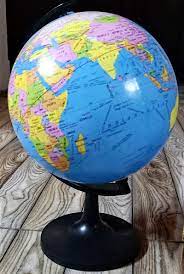
A globe is a spherical model of Earth, of some other celestial body, or of the celestial sphere. Globes serve purposes similar to maps, but unlike maps, they do not distort the surface that they portray except to scale it down. A model globe of Earth is called a terrestrial globe. A model globe of the celestial sphere is called a celestial globe.
A globe shows details of its subject. A terrestrial globe shows landmasses and water bodies. It might show nations and major cities and the network of latitude and longitude lines. Some have raised relief to show mountains and other large landforms. A celestial globe shows notable stars, and may also show positions of other prominent astronomical objects. Typically, it will also divide the celestial sphere into constellations.
The word globe comes from the Latin word globus, meaning “sphere”. Globes have a long history. The first known mention of a globe is from Strabo, describing the Globe of Crates from about 150 BC. The oldest surviving terrestrial globe is the Erdapfel, made by Martin Behaim in 1492. The oldest surviving celestial globe sits atop the Farnese Atlas, carved in the 2nd century Roman Empire.
Terrestrial and planetary
Flat maps are created using a map projection that inevitably introduces an increasing amount of distortion the larger the area that the map shows. A globe is the only representation of the Earth that does not distort either the shape or the size of large features – land masses, bodies of water, etc.
The Earth’s circumference is quite close to 40 million metres. Many globes are made with a circumference of one metre, so they are models of the Earth at a scale of 1:40 million. In imperial units, many globes are made with a diameter of one foot, yielding a circumference of 3.14 feet and a scale of 1:42 million. Globes are also made in many other sizes. Yet, the conclusion is that the globe is the spherical model of earth.
Technology
Uploaded on Aug 15, 2022

Technology is the result of accumulated knowledge and application of skills, methods, and processes used in industrial production and scientific research. Technology is embedded in the operation of all machines and electronic devices, with or without detailed knowledge of their function, for the intended purpose of an organization. The technologies of society consist of what is known as systems. Systems operate by obtaining an input, altering this input through what is known as a process, and then producing an outcome that achieves the intended purpose of the system.
The earliest and simplest form of technology is the development of knowledge that leads to the application of basic tools. The prehistoric invention of shaped stone tools and the discovery of how to control fire increased the sources of food that were available to human beings. The invention of the wheel led to the travelling technologies that helped humans to further increase the yield of food production, travel in less time, and exchange information and raw materials faster. Humanity then progressed to the development of the printing press, the telephone, the computer, and then the Internet.
While technological advances have helped economies develop and create the rise of a leisure class, many technological processes produce unwanted by-products, known as pollution, and the depletion of natural resources from the Earth’s environment. As a consequence, philosophical debates have arisen over the use of technology and whether technology improves or worsens the human condition. Neo-Luddism, anarcho-primitivism, and similar reactionary movements criticize the pervasiveness of technology by stating that technology harms the environment and destroys human relationships. While this is the case, ideologies such as transhumanism and techno-progressivism view continued technological progress as beneficial to society and the human condition.
While innovations have always influenced the values of a society and have raised new questions in the ethics of technology, the advancement of technology itself has also led to the pursuit of new solutions for the previously discussed concerns of technological advancement. For example, upcoming technology involves renewable resources being used in transportation, allowing humans to travel in space, for technology itself to become more affordable and reliable, and for increased automation.
 Arshii Sangar